These days, wherever I travel, I can't help analysing the playgrounds I come across. This one in Tiong Bahru Park is the one I pass most often, because I live nearby, and from a paediatric OT's point of view I think it is quite good. So I decided to analyse it properly and share what I see.
This page is a general guide for parents. It looks at how you can facilitate play at the playground, what the different pieces of equipment can do for your child's development, and what to look out for while you play alongside them. It is about this playground, but you can take the same questions to any playground you visit.
I see this playground in all kinds of weather. On cooler, less glaring days the swings are busy, children turn up with sand buckets and spades, and the slides are rarely empty. It is the kind of place where you can watch children choosing their own challenges.
Through an OT lens, a lot of quiet work is going on. The swings give vestibular input (the movement and balance sense). Climbing, digging into the sand and hanging give proprioceptive input (the sense of where the body is and how hard the muscles and joints are working). Uneven floors ask the ankles, and the hips, to keep adjusting. And the whole place makes room for lots of different kinds of play. This page walks through it photo by photo.
How to explore this page
- Look for the pulsing dot on each photo.
- Hover over a part of the photo (or tap it on a phone) to open a note on what it works on.
- Use the filter bar below to fade everything except, say, the parts that give vestibular input.
- Prefer to read? Every photo has a "read the notes as text" list underneath.
- Want to take it with you? Download the one-page sensory motor map.
1. Start with the ground
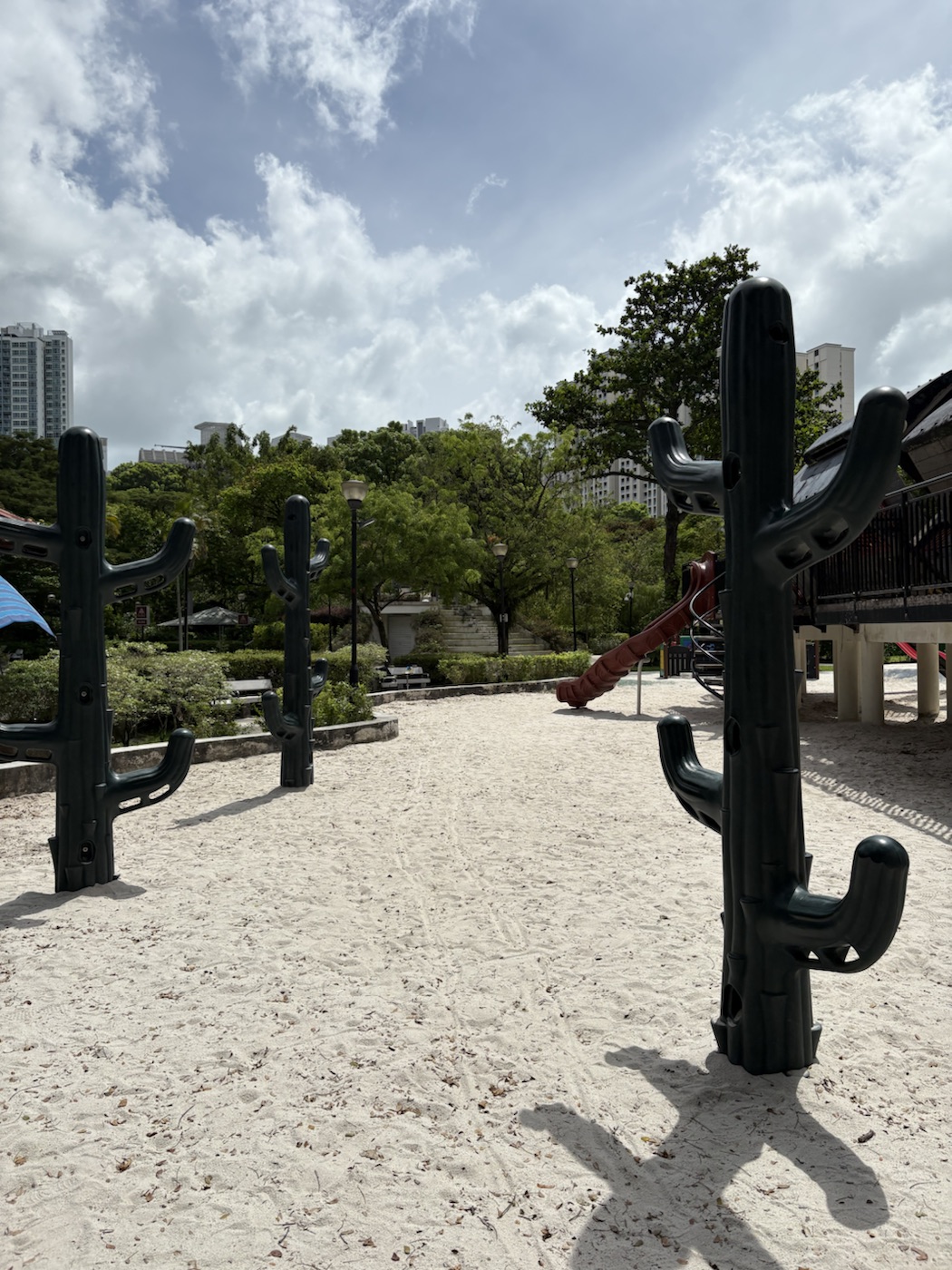
Before any equipment, there is the sand. It covers the whole play area, and it is the most open-ended thing in the park.
Read the notes for this photo as text
The sand itself
Every step on the loose sand asks the feet and ankles to adjust a little, which is a good balance activity in addition to the tactile input it provides. Digging, scooping, carrying and pouring are good heavy-work activities that give the muscles and joints plenty of proprioceptive input, or resistance to their shoulder and wrist joints, which many children find organising.
It also holds several kinds of play at once: solo play at their own pace, parallel play (side by side, each on their own project), and creative play when children bring buckets and spoons, or use leaves and sticks as materials.
Notice: some children don't like the feel of sand at first. Letting them watch from afar, use a tool, or keep their shoes on is a good way to start.
Cactus poles
These look mostly like a design element, but the arms work like rungs. A child can step up on a low arm and hang on to a higher one, which pushes and pulls through the joints which provides proprioceptive input. The desert setting also suit pretend play.
Notice: a good example of equipment that isn't built for just one job. You'd be surprised that children find uses the designer may never have planned.
2. Swings: good source of vestibular input
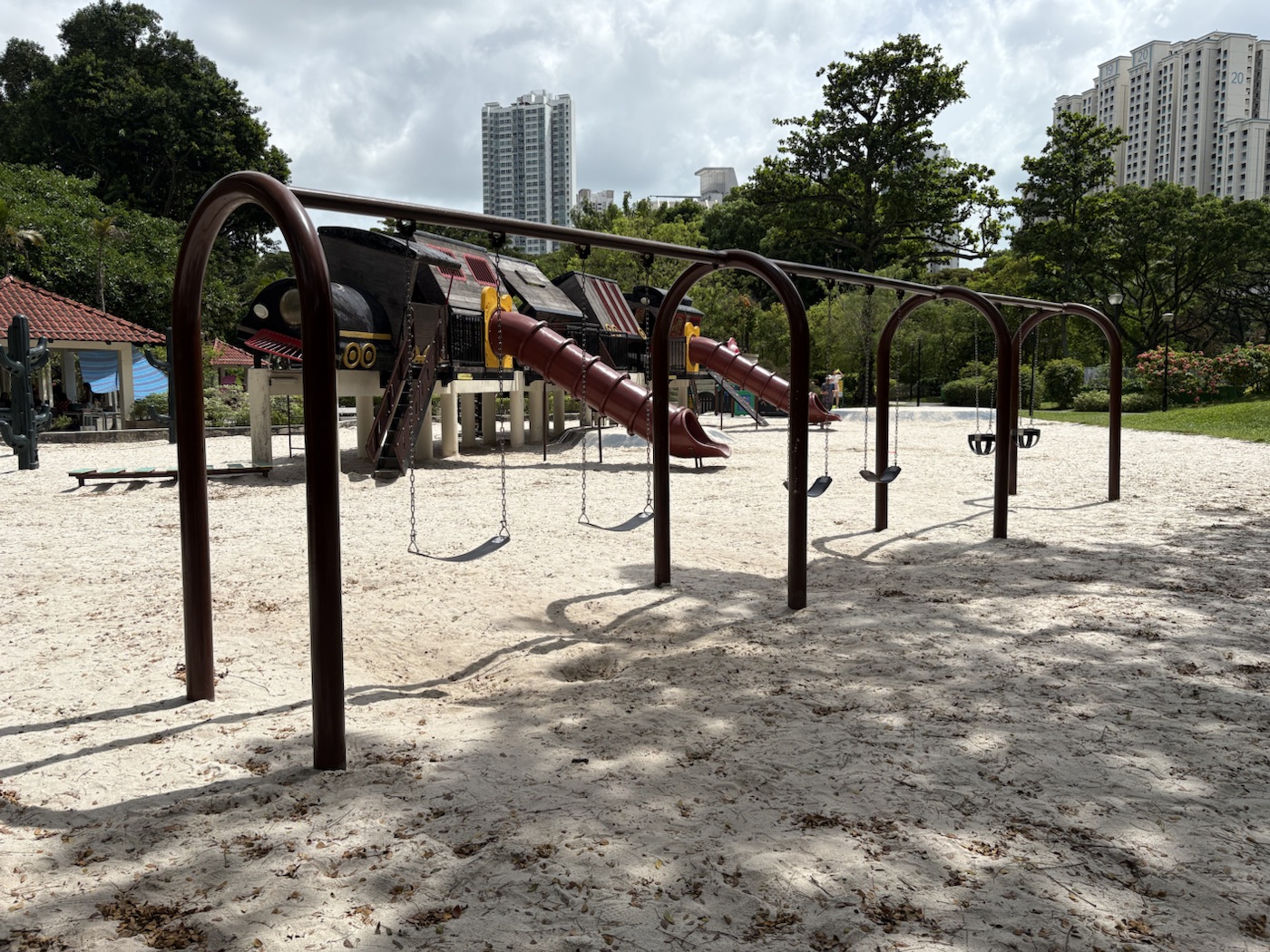
Swings are a great source of linear vestibular input, the kind that tells your child’s brain about movement and balance. Slow, steady swinging tends to calm and organize, while faster swinging is more alerting. Either way, your child is building core strength, balance, and coordination, and they just think they’re playing.
Read the notes for this photo as text
Belt swings
Swinging gives linear vestibular input, and how it feels depends on speed. In OT practice, slow, steady, rhythmic swinging is generally calming, while fast or unpredictable swinging tends to be alerting.
Pumping the legs adds timing and coordination, and holding on gives the hands and arms proprioceptive input.
Notice: a gentle sway after a long day, or big fast swings first thing in the morning can tell you what your child's body is wanting.
Bucket seats for little ones
The high sides hold the trunk upright, so younger children can enjoy the movement without having to hold themselves up. For many it is a first taste of linear vestibular input, with an adult deciding the speed.
Notice: start slow and watch their face and body. Relaxed, smiling and asking for more usually means the speed is about right.
The space around the swings
A long row of swings lets friends and neighbours swing side by side, race, or take turns pushing. Waiting, asking and sharing are good opportunities to practise social skills in a real setting.
Notice: Give children a chance to work out conflicts on their own before you step in. Waiting a moment lets them practice turn-taking, negotiating, and problem solving.
3. See-saw and spring riders
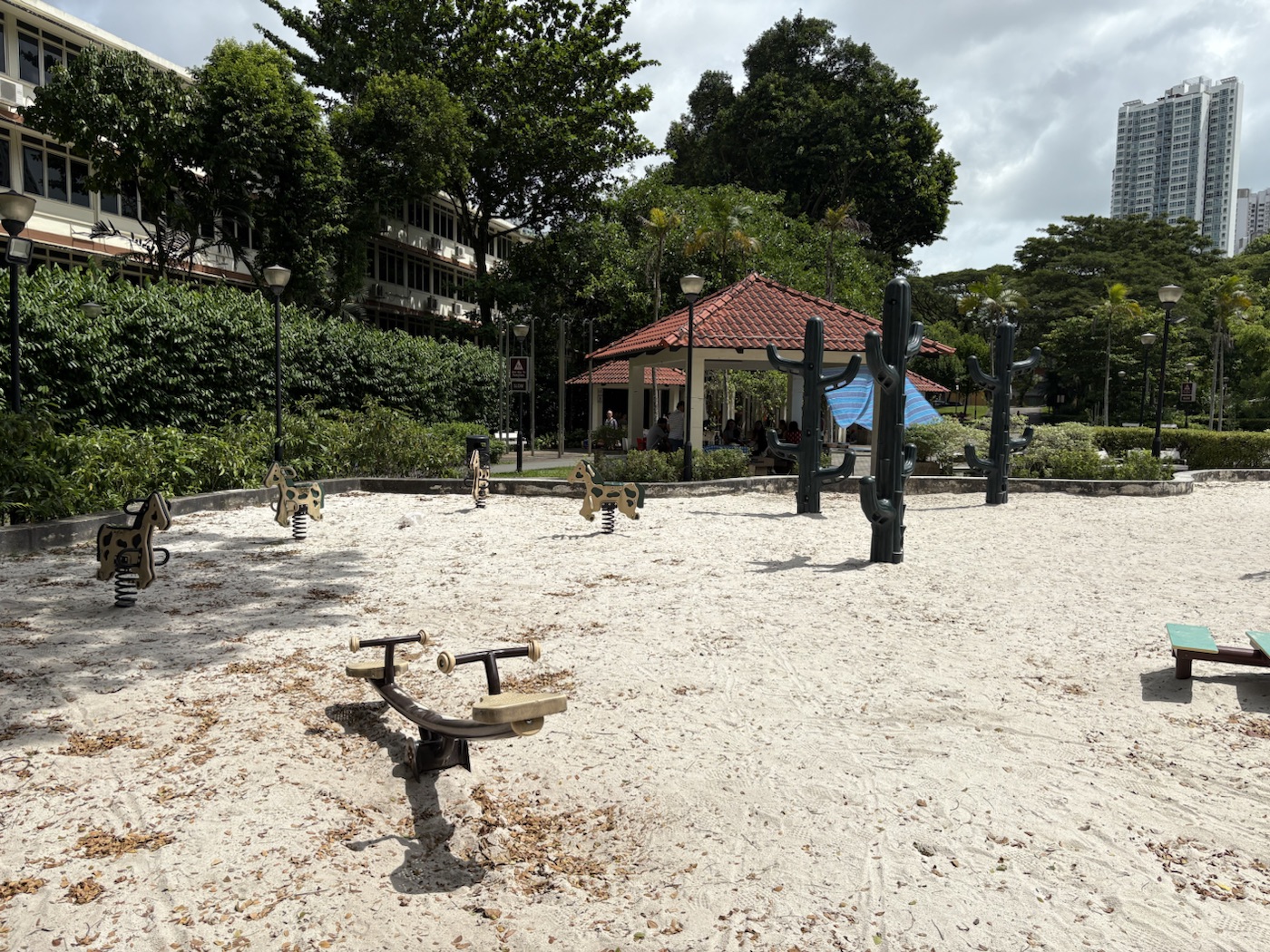
These are small pieces of equipment, but each asks for something different. The see-saw needs two people. The spring riders can be used alone.
Read the notes for this photo as text
See-saw
A see-saw gives linear up-and-down vestibular input, and it only works with a partner. Children match their timing, push off with their legs (proprioceptive input through the feet and knees) and negotiate: who pushes, how high, when to stop. Staying balanced on a seat that keeps moving also asks the trunk and hands to hold on and adjust.
HDB's new Play Values Framework names the see-saw as an example of play for pairs, and it is a good one.
Notice: a see-saw teaches cause and effect fast. When your partner stops pushing, you feel it straight away.
Spring riders
Rocking back and forth on a spring is rhythmic movement, which many children find organising and calming. Staying on takes core strength, grip strength and balance, and the horse shape tends to start a pretend game.
Notice: a good choice for a child who needs movement but isn't ready for a big swing.
4. The train
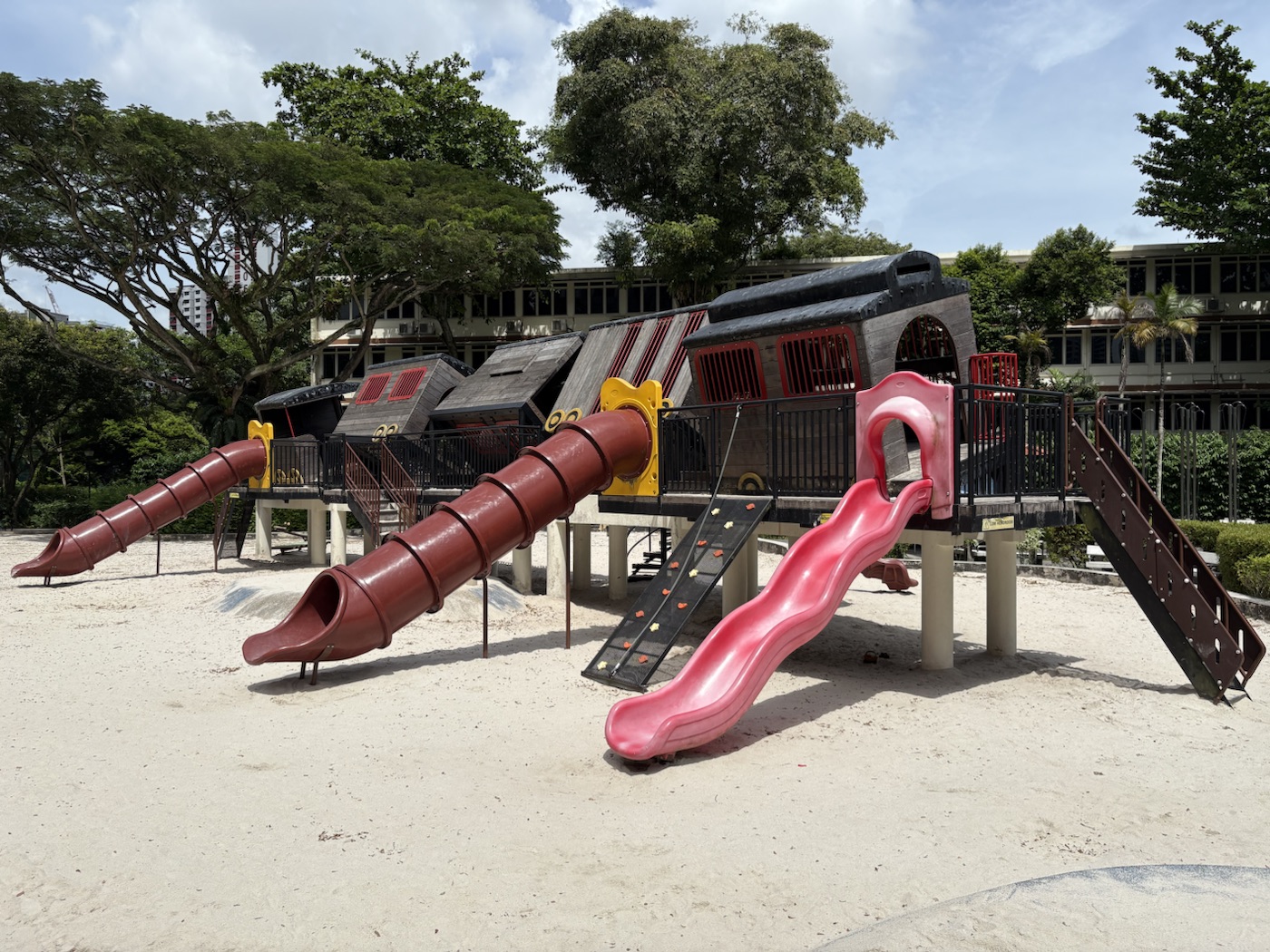
Now the main event. The train has carriages, raised up on pillars and set at an angle. There are three ways down (tube slide, open slide, stairs) and several ways up.
Read the notes for this photo as text
The tilted carriages
This is the heart of the playground. The carriages are set at various angles, so the floor under a child's feet is never quite level. To maintain upright balance, the body keeps making small corrections at the ankles (often called ankle strategies), with the hips, trunk and perhaps hands joining in as well as the challenge grows.
Notice: a level playground rarely asks for this. Uneven ground is one of the few places children get to practise adjusting on the move.
Tube slides
Slides give fast linear vestibular input, and the speed is usually alerting. Children can choose between the enclosed tubes and the open slides, so they can pick the amount of speed and enclosure they are ready for.
Notice: Some children might be scared of being in an enclosed space, so perhaps watching others first, and offering other options would be good.
Wavy slide
The waves change the speed in small bursts, so the body keeps adjusting on the way down. An open slide like this lets children see where they are going, which many find less daunting than a dark tube.
Notice: sitting up or lying back, going feet first are all different postures, and each asks something different of the trunk.
Climbing ramp
The coloured grips/holds ask hands and feet to work together. Pulling and pushing the body up a slope gives strong proprioceptive input, and finding a route builds motor planning.
Notice: let them find their own route. If they are stuck, a question ("where could your hand/foot go?", "Could your right hand go up to the yellow hold?") works better than lifting them up.
Stairs and ladders
Several ways up with different steepness. Alternating feet while holding a rail builds strength and coordination, and choosing a route lets children pick a challenge they feel ready for.
5. Under and around the train
Some of the best parts of the playground are on the ground, in the spaces around the structure rather than on it.
Read the notes for this photo as text
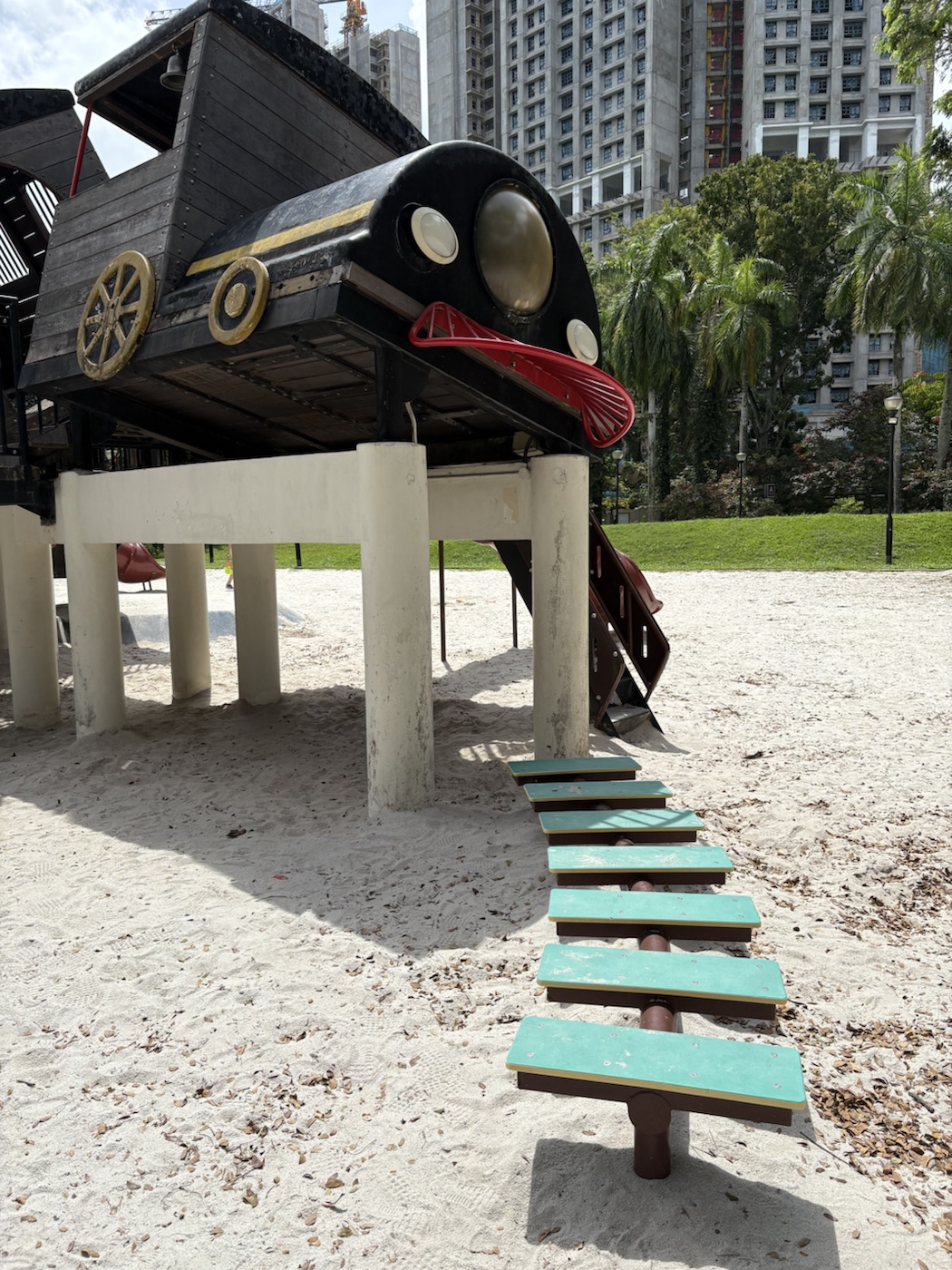
The front of the train
Children pretending to be the driver, conductor and passengers make for cooperative pretend play.
Notice: a theme can start a game.
Under the train
The shaded space underneath the pillars makes a natural den. It is good for hide-and-seek and imaginative games, and it is also a place to step out of the action for a moment, which some children need when things get loud. In Singapore's heat, the shade matters too. Children can play with sand under the shade here- a good option during a hot day!
Notice: a quiet corner is part of a playground's play value, not a break from it.
Stepping planks
These planks are fixed, so they don't tip, which makes them a very safe place to practise. Stepping from one to the next asks for careful foot placement, motor planning and close visual attention to the feet. Children can walk them like a balance beam, hop, or invent a game: follow the leader, stepping stones across a river.
Notice: because the planks are steady, they suit children who are wary of wobbly surfaces. They make a good first step before the tilted train.
6. Going up
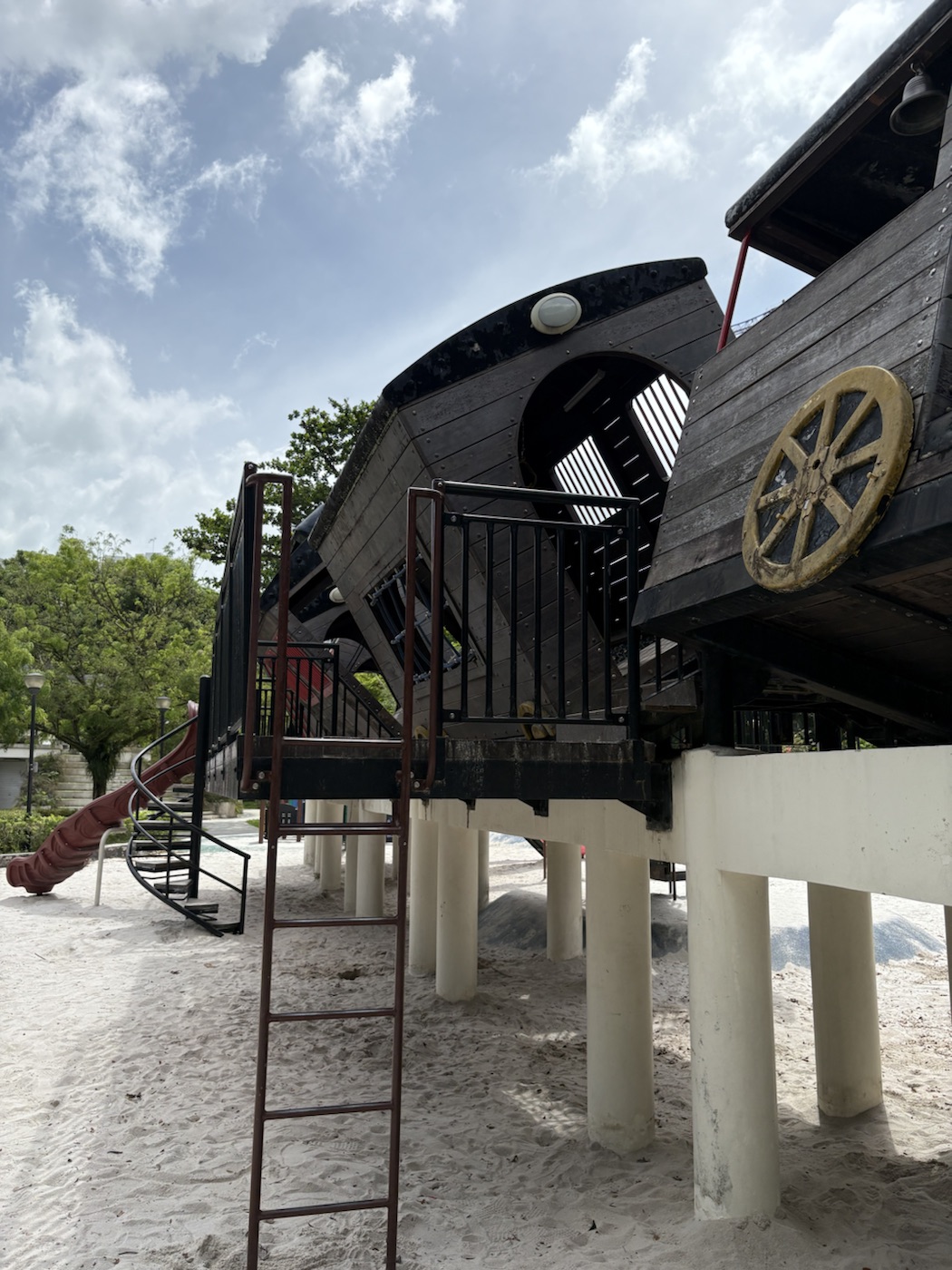
The train sits on tall pillars, so getting on is already a small expedition. Children choose a route and a height.
Read the notes for this photo as text
Vertical ladder
A vertical ladder asks for a steady hand-foot-hand-foot rhythm, a strong grip and a lot of body awareness. It is a classic heavy-work climb, and it gives children a clear way to test their own limits: how high, how fast, how confident.
Notice: let them decide how high to go. Children who choose their own height often know their limits better than we expect.
7. Inside the train
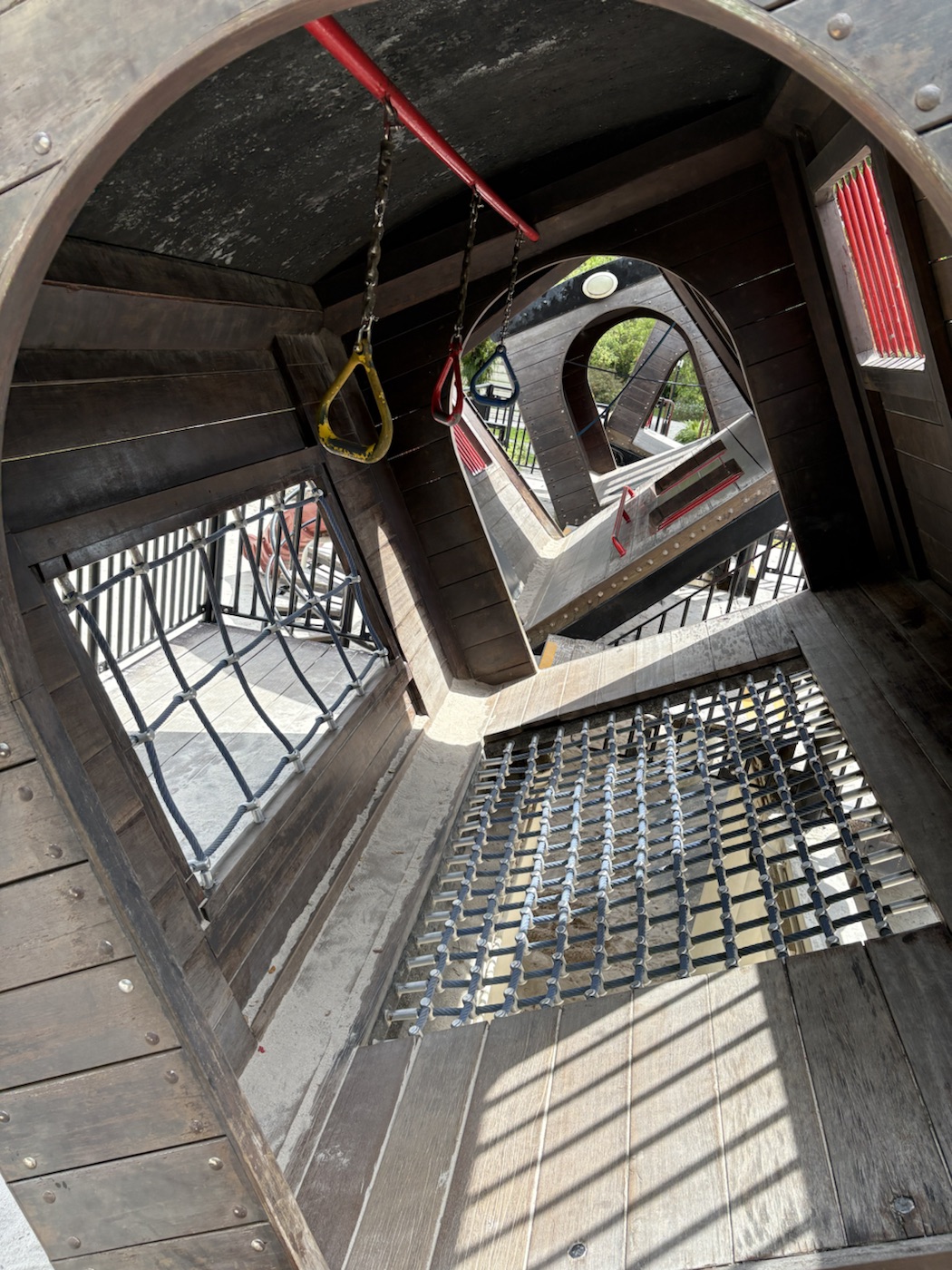
Step through the arched doors and you are in a tilted wooden room with rings, rope nets and windows that frame the park. Nothing in here is level.
Read the notes for this photo as text
Hanging rings
Hanging from the rings puts the child's body weight through the hands, arms and shoulders, which is good proprioceptive heavy work. A swing or sway adds a little vestibular input, and the grip builds the hand strength behind many everyday skills.
Rope net floor
A floor you can see through, and feel through the soles of the feet, asks for careful foot placement and plenty of visual attention. The floor shifts with each step, which adds movement and balance input for the vestibular system. It might be scary for some. Children can look down, take it in, and decide how far to go.
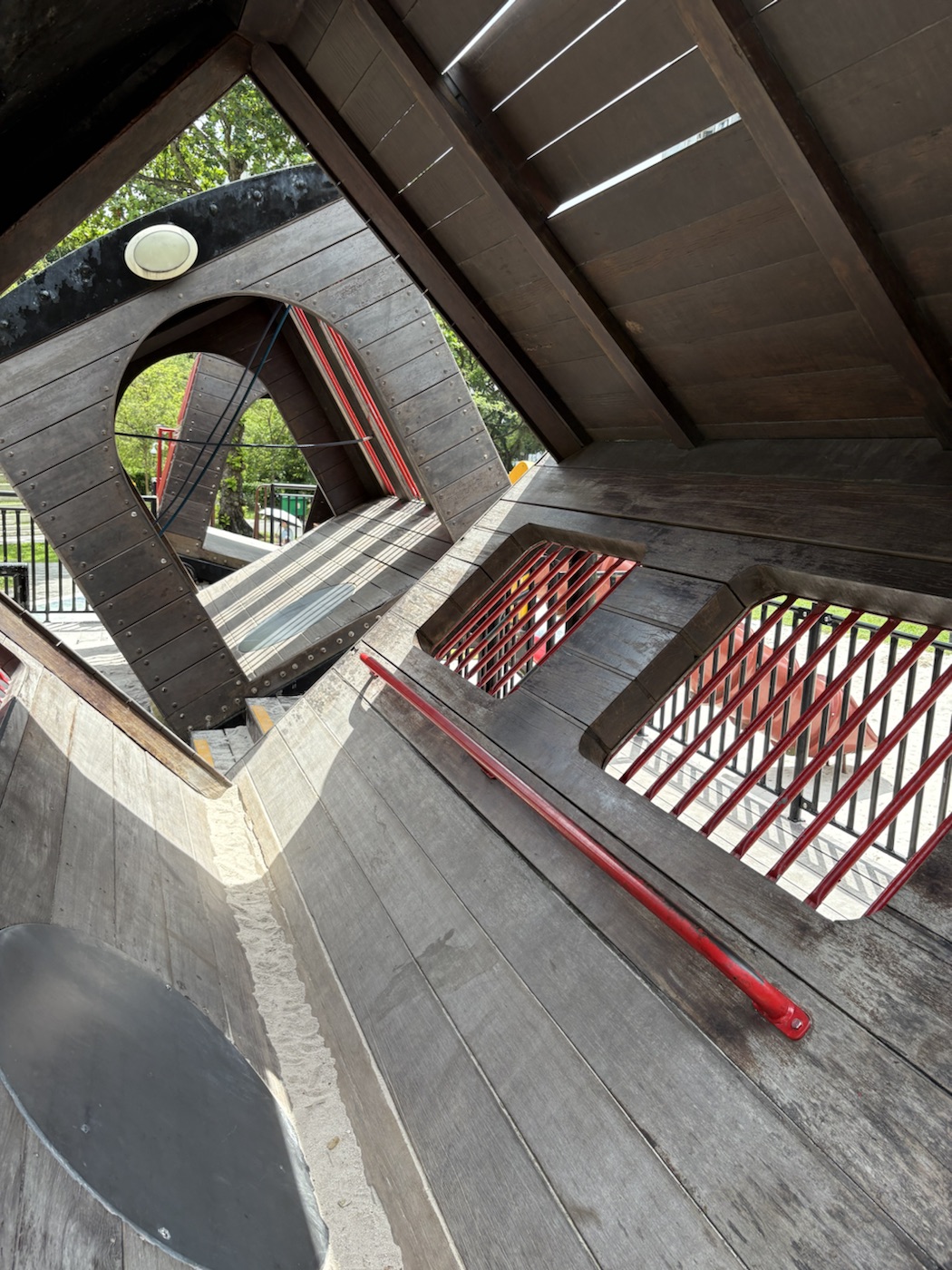
The tilted room
Inside, the whole room slopes. Crossing it means leaning against the slope with ankles, trunk and hands, and the tilted view can feel odd while the eyes and inner ear sort out what is level. It is a good way to practise the brain-body teamwork behind balance.
Read the notes for this photo as text
Handrail
A rail at child height lets each child choose how much support to use: a full grip, a light touch, or none. That choice builds confidence one step at a time.
Notice: the first time a child lets go is worth a quiet smile.
Arched openings
Round openings frame the view like windows, and they are made for peeking, calling out and chasing. The shapes and the light change how the space feels, which is part of why the train works as a stage for pretend play.
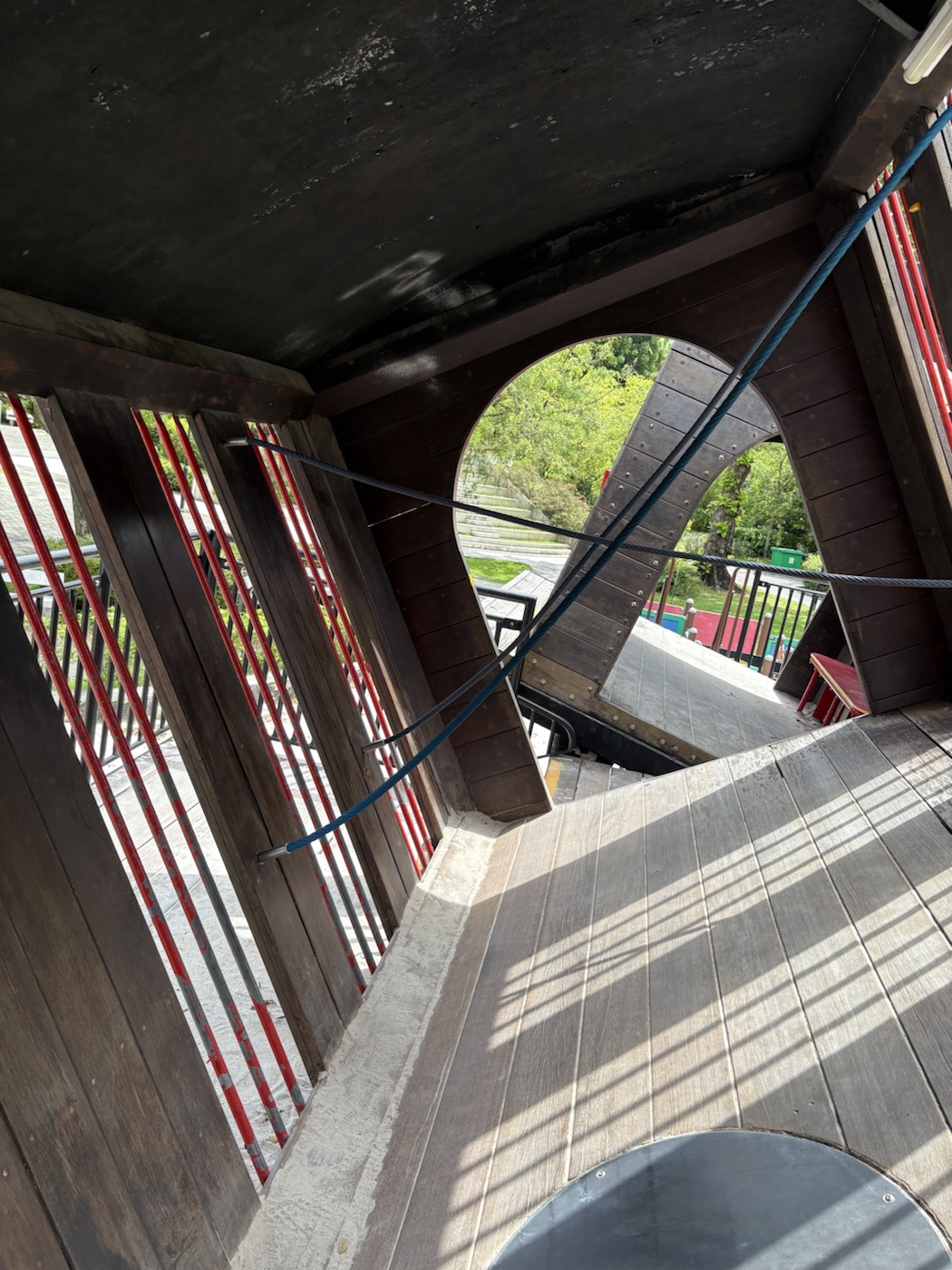
Read the notes for this photo as text
Cables
The cables run across the tilted cabin at different angles. They look like extra support for crossing, and children can reach out and work out which one to hold, and at what angle, to get across. That is real problem-solving with the whole body.
Notice: there is no single right answer. Each is a solution.
8. Back down: inside the tube
From the top of a tube slide.
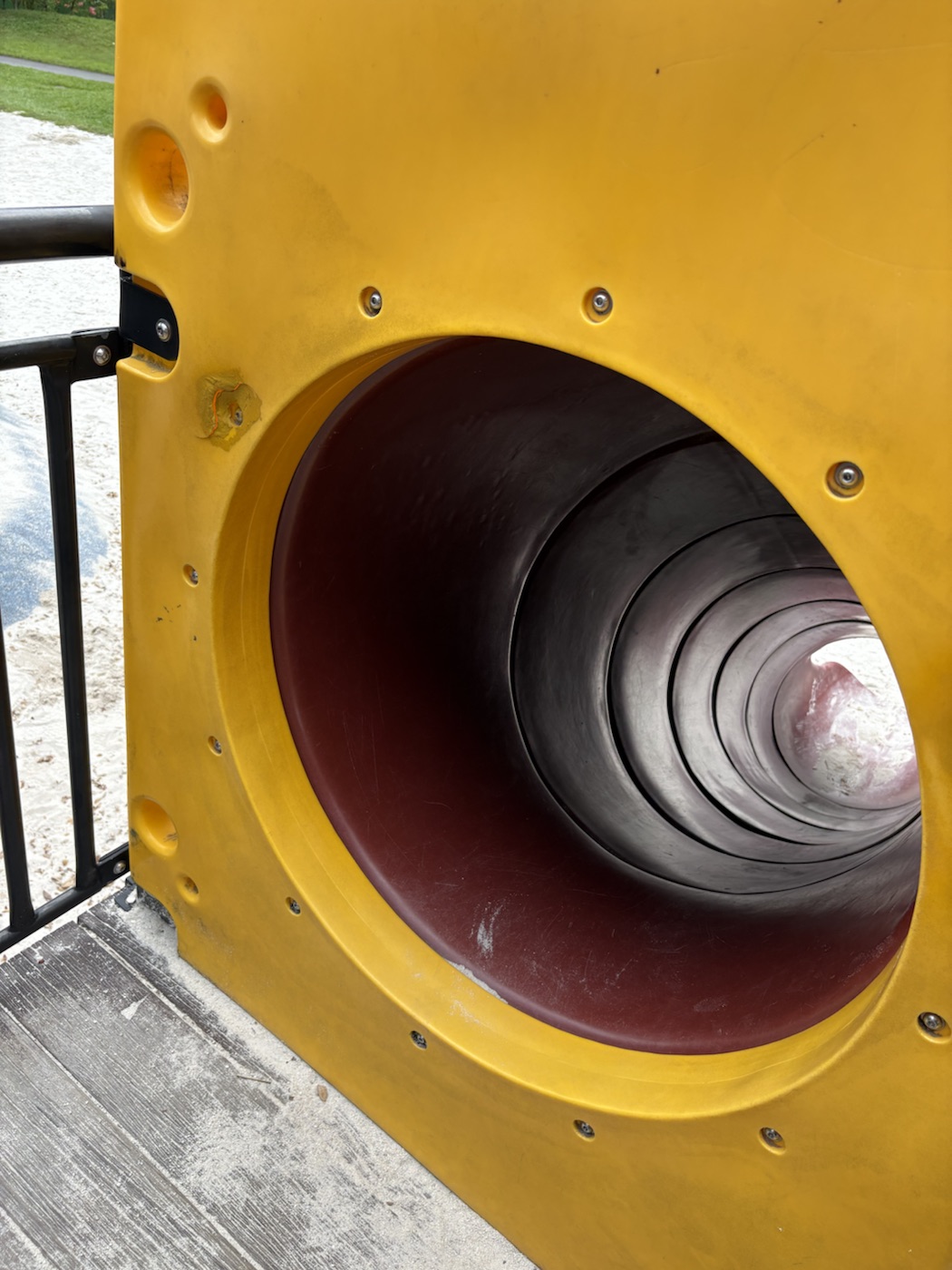
Read the notes for this photo as text
Inside the tube
From the top, the tube is a dark, curved tunnel. For some children that enclosed feeling is calming, almost like a cocoon. For others it is too much, and they will prefer the open slide. Both reactions are useful information about how a child handles sensory input.
Notice: never push a hesitant child down. Looking, touching and watching others go first are all steps in.
A framework worth watching: HDB's Play Values
That is the tour. To put what we have seen in context, it helps to look at how playground design in Singapore is changing. In December 2025, HDB announced a Play Values Framework to guide how new playgrounds are designed. It applies from January 2026 to playgrounds in newly tendered BTO projects and new HDB parks, and it was shaped with input from parents, early childhood and health professionals, and playground specialists.
Tiong Bahru Park is an NParks park, and this playground reopened after a revamp in September 2018, so it predates the framework and sits outside it. But it is a useful lens. How much of what the framework describes can you already see here?
HDB's Play Values Framework: three key aspects of play
The framework emphasises three key aspects of play: physical, social and creative. Here is HDB's own summary of each, followed by what you can see of each at Tiong Bahru.
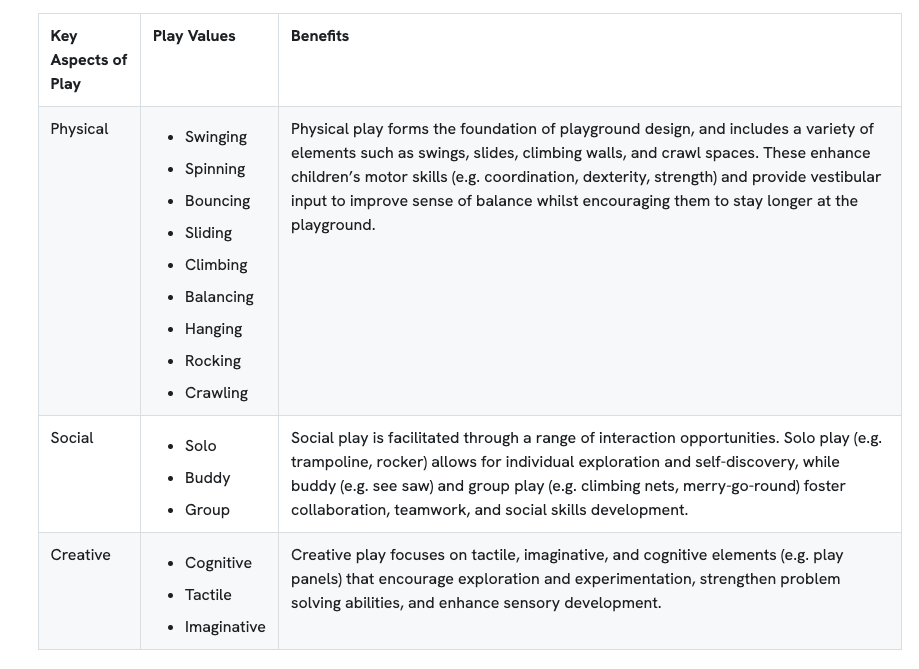
Physical play
Swinging, bouncing, sliding, climbing, balancing, hanging, rocking, crawling, which enhance children's motor skills (like bilateral coordination, dexterity and strength) and provide vestibular input to improve their sense of balance, as well as proprioceptive input to improve their body awareness.
- Here: swings, spring riders, slides, ladders, the climbing ramp, the stepping planks, cactus poles, see-saws, the tilted floors
Social play
A mix of solo, pair and group options. HDB's examples include a trampoline or rocker for one, a see-saw for two, and climbing nets or a merry-go-round for a group.
- Here: the spring-rider, cactus poles, see-saw, the row of swings, the train, and space around the train.
Creative play
Tactile, imaginative and cognitive features, such as play panels, that invite exploring, experimenting and problem-solving.
- Here: the sand, the train story, the dens under and inside the carriages, the cables to figure out
What I find promising
- It names social and creative play next to physical play. Many playground checklists stop at "does it have a slide?"
- It thinks in group sizes. Solo, buddy and group play need different kinds of equipment, and a good playground offers all three.
- Health professionals were at the table. That is where ideas about vestibular and proprioceptive input, and about building motor and social skills, can be heard.
A playground should be judged by what children do in it, not by how it looks on paper.
On your next visit
- Let your child choose the level. Higher, faster or slower is their call, within the limits you've set.
- Wait a few seconds before helping. Struggle often looks worse from the outside than it feels.
- Bring a few loose parts. A bucket, a spoon, a sieve or a cup turns sand into a kitchen, a building site or a river.
- Watch what they seek and what they avoid. It tells you a lot about what their body is looking for.
- Tell me what you see. Which part of this playground does your child love most? Share it on Instagram.
Take it with you
A one-page "playground sensory motor map" for your next visit: the main parts of the playground, what they work on, and what to try.
Open the one-page mapA note
The sensory descriptions on this page are about everyday play: how movement tends to feel and what it asks of the body. They are not a treatment plan. If you have a worry about a particular child, please consult a qualified therapist.
Sources and further reading
- HDB: New HDB playgrounds to enhance children's play experiencesHDB's own announcement of the Play Values Framework (December 2025), with the three kinds of play and what each is for.
- Little Day Out: Tiong Bahru Park, tilting train playground, therapeutic garden and moreA parent's guide to the 2018 revamp, with details of the train and what's nearby.
- NParks: Tilting train playground at Tiong Bahru ParkNParks' own description of the park's tilting train playground.
This article is educational and describes general patterns in how children respond to play. Every child's sensory preferences are different, and nothing here is individual clinical advice. If you're concerned about a child, speak with a qualified health professional. Full disclaimer.