Over the last four Instagram posts I’ve been asking one question: what happens to the children who are too mild for a diagnosis-based pathway, but still struggle to take part in a mainstream classroom? This article puts some numbers behind that question.
A quick disclosure first. I worked at AWWA for over four years before moving into private practice, and I have deep respect for their work. This isn’t a critique of AWWA or of any school, teacher or ministry. It’s about the size of the need beyond what any one programme can realistically cover. Views shared here are my own and don’t represent the views of my employer.
The four posts in brief
- The kids in the middle. Children with milder sensory, fine motor or speech needs often don’t qualify for SPED, yet mainstream schools have no embedded allied health support for them.
- Behaviour problem, or sensory? A lot of what is managed as a behaviour problem has a sensory or regulation need underneath. Once that is understood, the response changes.
- Therapists as allies. One partnership between a teacher and an OT can change how a whole classroom is read, not just how one child is seen.
- The allied advantage. Embedded support isn’t an extra. It means OT and speech therapy become part of the school day, the way a school nurse or counsellor already is.
What exists today: AWWA’s Community Integration Service
AWWA’s Community Integration Service (CIS, formerly TEACH ME) began in 1991 and is the main dedicated allied health programme embedded in MOE mainstream schools. Its interdisciplinary team includes physiotherapists, occupational therapists, speech and language therapists and social workers. School-based support for students in mainstream primary, secondary and tertiary schools is subsidised by the government based on means testing results.
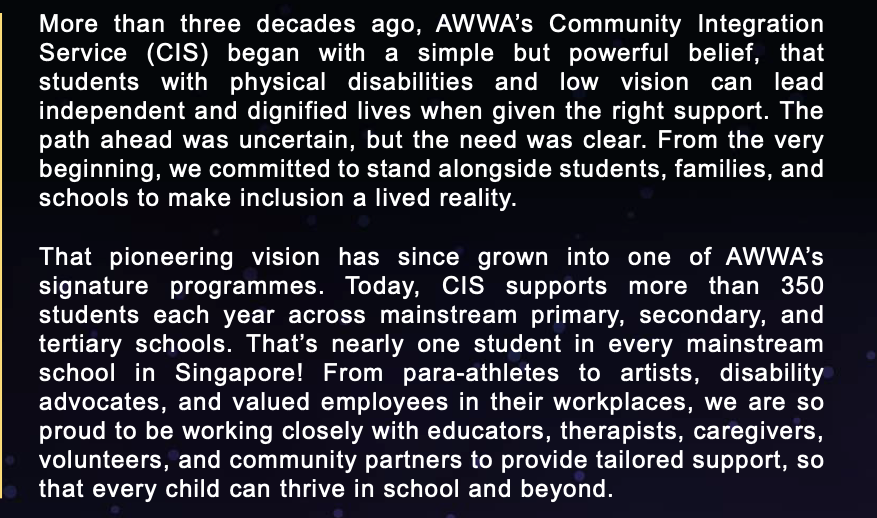
AWWA reports that CIS supports more than 350 students a year across mainstream primary, secondary and tertiary schools, which it describes as nearly one student in every mainstream school. That is real, valuable reach, delivered by one team.
CIS’s criteria are specific by design. It serves Singapore citizens and PRs aged 7 and above in mainstream schools or institutes of higher learning who have a medical diagnosis of a physical disability, low vision, a speech disorder (including fluency disorder) or developmental coordination disorder. Students whose primary diagnosis is autism, ADHD, dyslexia or a language disorder fall outside those criteria, as do students recommended to SPED. A mainstream classroom sees a much wider range of sensory, motor and regulation needs every day.
Source: AWWA CIS Scope of Services fact sheet (updated 30 May 2025), pp. 1-3. Read the admissions and exclusion criteria rows there.
The size of the system
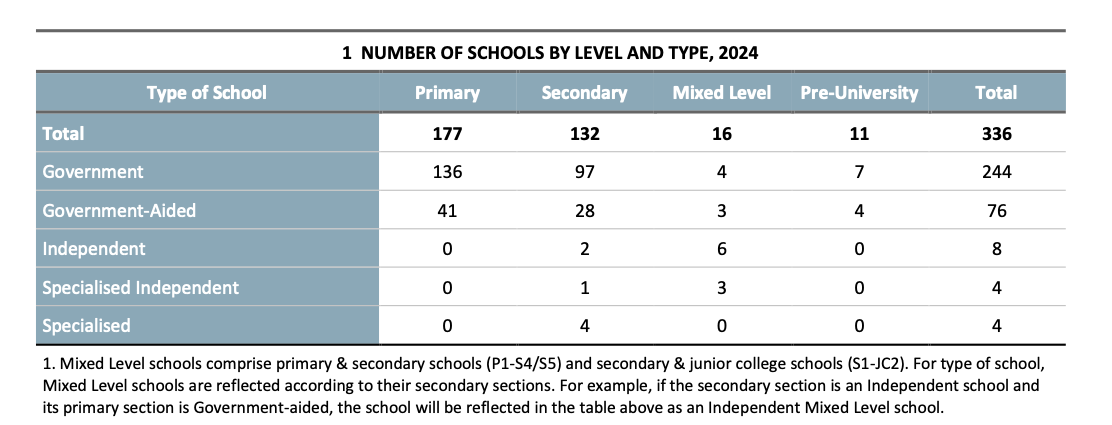
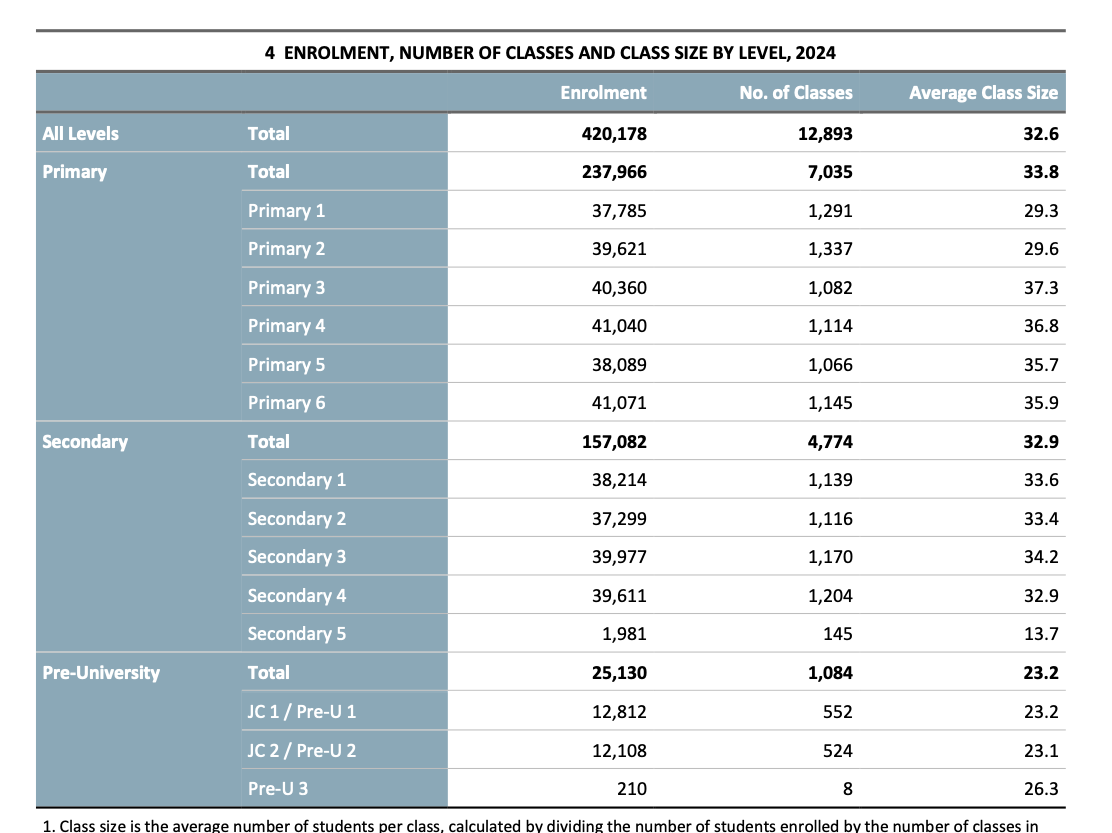
MOE’s Education Statistics Digest lists 177 primary and 132 secondary schools, which is where the figure of about 309 comes from. Adding mixed-level schools and junior colleges takes the total to 336. Enrolment in the digest’s 2024 data was 237,966 in primary and 157,082 in secondary, about 395,000 children in total. (The digest is titled 2025 but its tables are for 2024, and the combined totals are my own addition.)
The size of the need
The EveryChild.SG report Mind the Gap estimates that roughly 27,000 mainstream students, 1 in 14 or 7%, have a SEN diagnosis. The authors say the real number is probably higher once undiagnosed children are counted, and note that a class of 30-40 will almost certainly include two or three students with SEN, and possibly a few more without a diagnosis. The report concludes that, generally speaking, therapy services are not available to students on school campuses today.
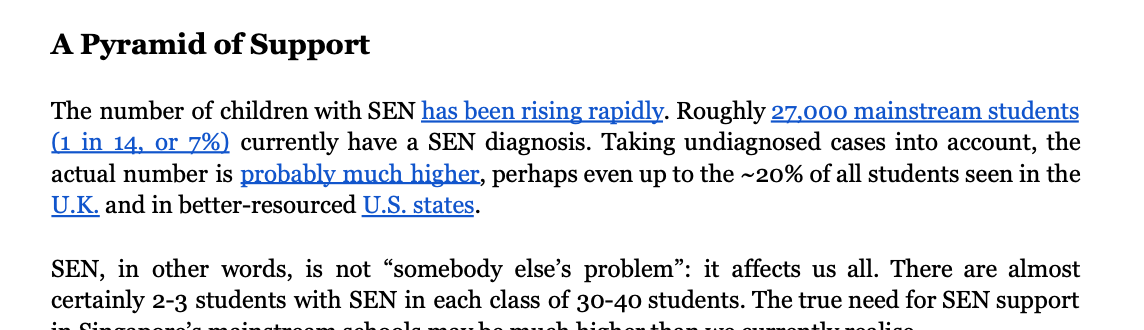
Putting the two figures side by side, 350 CIS students against 27,000 students with a diagnosed SEN is just over 1%. I offer that as an illustration of scale, not an official statistic: the two numbers come from different sources, CIS also serves tertiary students, the report’s focus is primary education, and CIS’s diagnostic categories don’t map neatly onto “SEN” as a whole. And it leaves out children who struggle daily to sit, focus, transition or join in, but have no diagnosis at all. For them there is no structured in-school pathway.
What families do instead
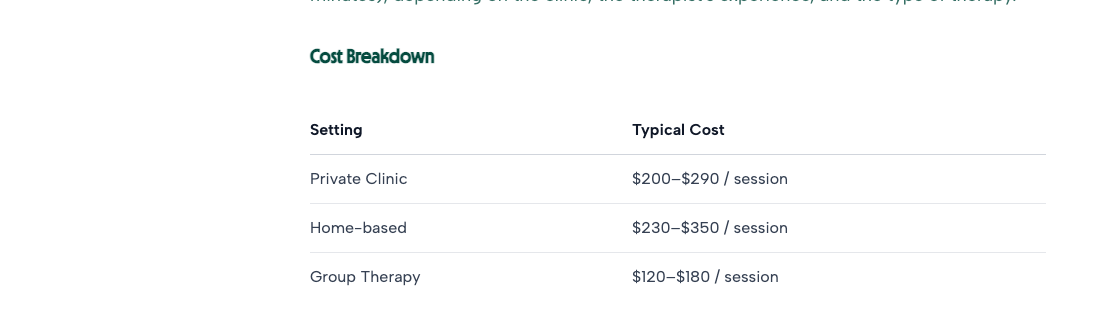
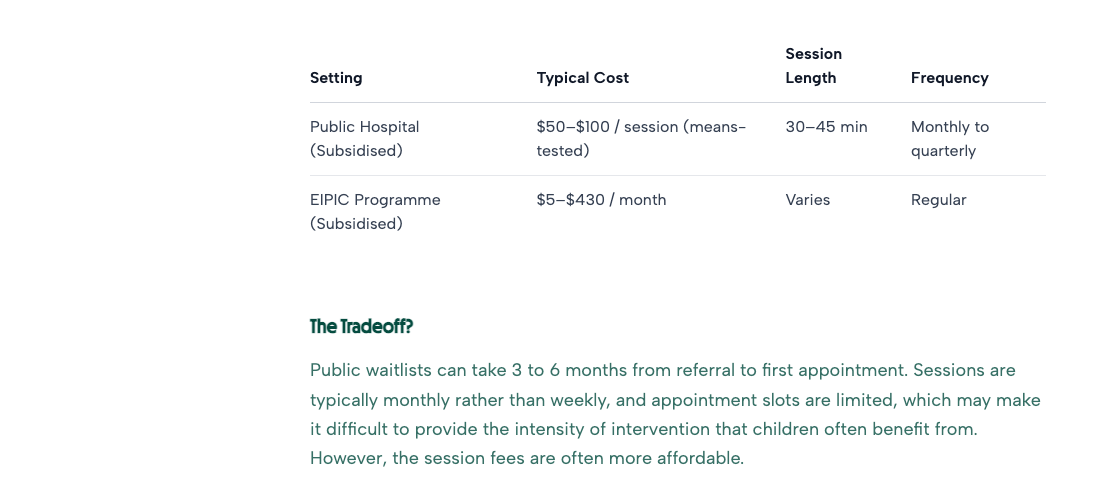
Families outside CIS’s criteria generally turn to private therapy or public hospital services. One Singapore clinic’s published guide puts private OT and speech therapy at about $200-$290 per session in a clinic and $230-$350 at home, while public hospital sessions are about $50-$100 but often involve a three to six month wait and monthly to quarterly sessions. These are one provider’s estimates, so actual fees vary. As an illustration, weekly sessions at $200-$350 would add up to roughly $10,400-$18,200 a year (my own calculation).
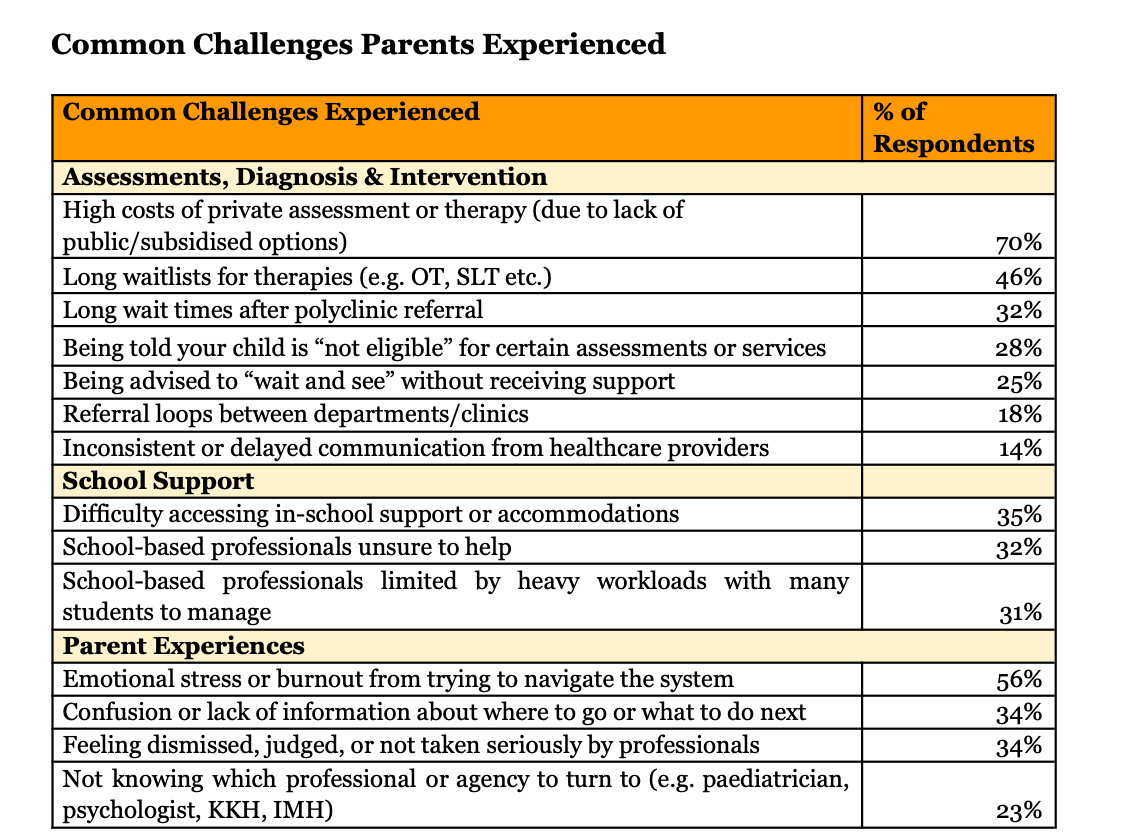
The Mind the Gap parent survey points the same way. Of the 71 parents who took part (parents of primary school-aged children who are diagnosed or suspected to be neurodivergent), 70% cited the cost of private assessment or therapy as a challenge, 56% reported emotional stress or burnout, and 46% reported long waitlists for therapies. It was a small online survey, so it shows the shape of families’ experiences rather than a national picture.
A story about scale, not failure
None of this says anyone is failing. One programme, however excellent, was never going to cover an entire national school system. Singapore also has strong support in place: Allied Educators, SEN Officers, counsellors and MOE educational psychologists, though the report notes there are about 50 of the latter for mainstream schools, roughly one for every 8,000 students.
What closing the gap further could give
- Parents feel assured their child is seen, and that there might be a real reason behind their behaviour, diagnosis or not.
- Families no longer take time off work to reach a private appointment, because the support exists within the school day.
- Teachers learn to read behaviour differently, across a whole classroom, which over time shapes a more understanding school culture.
- Children benefit from simple supports such as movement/brain breaks, slant boards, ear defenders, dividers and alternative seating options being normal for any child who needs them, not a special accommodation for a few.
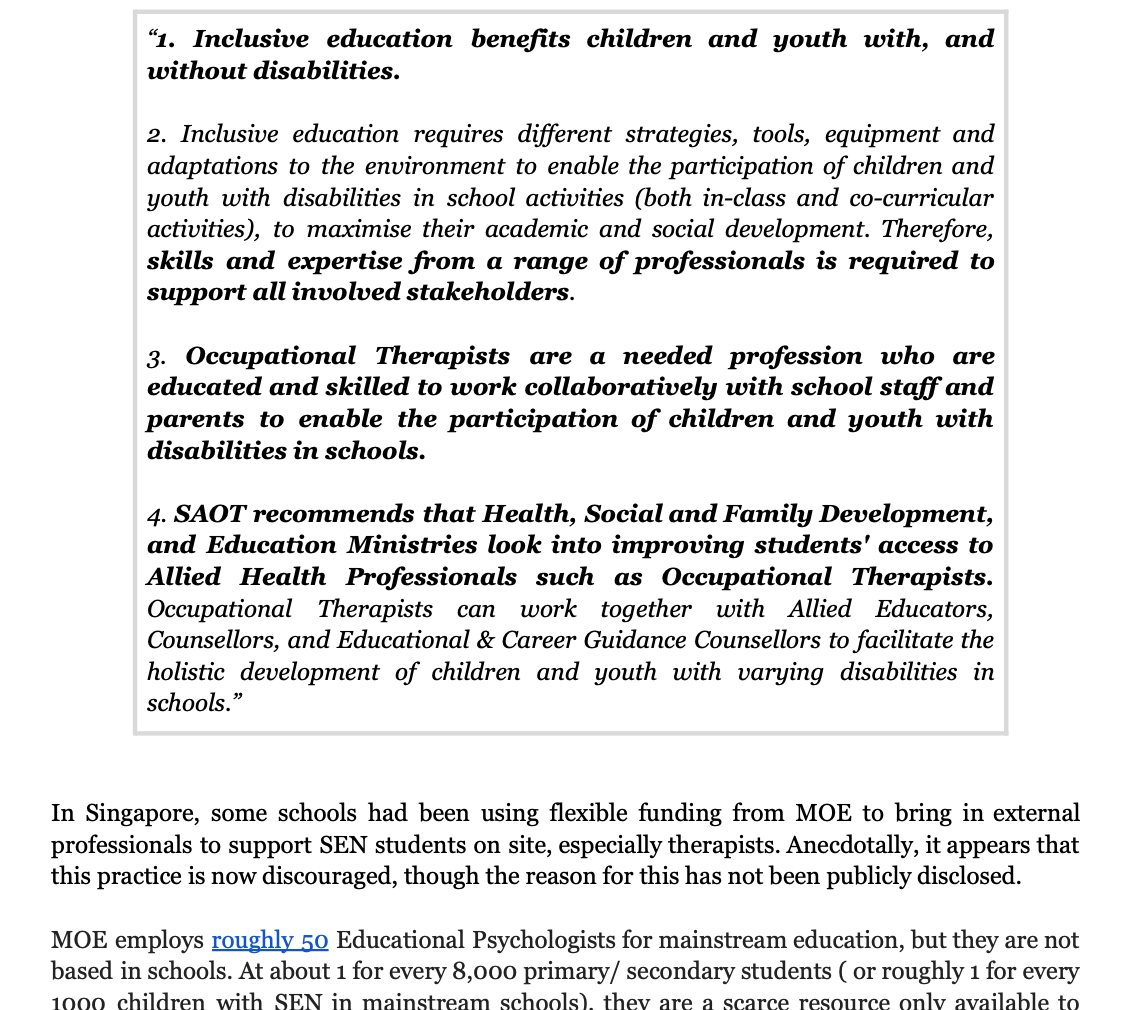
This is already how many international schools work, where OTs and speech therapists form part of the learning support team. The Singapore Association of Occupational Therapists has also recommended that access to OTs in schools be improved, and Mind the Gap recommends easy access to paediatric professionals for the whole school community.
Where it could start
My suggestion is modest: start with one OT in primary schools, show what it can do, and build wider acceptance over time. One OT in a school can be overwhelmed quickly, and schools will eventually need more than one, but we have to start somewhere. Programmes like CIS prove this is possible. I believe there is room, and real need, for more of it, for more children, with or without a diagnosis.
Join the conversation
If you’re a teacher, parent or therapist, I’d like to hear how this looks from where you sit. If any figure here looks off, please tell me and I’ll correct it. You can reach me on Instagram.
Sources
- AWWA. AWWA CIS Awards 2025 booklet.
- AWWA. Community Integration Service (CIS) Scope of Services fact sheet (updated 30 May 2025).
- Ministry of Education, Singapore. Education Statistics Digest 2025.
- EveryChild.SG. Mind the Gap: Navigating SEN Support in Singapore’s Mainstream Primary Education (20 Nov 2025).
- Ray of Joy Therapy. How Much Does Speech Therapy or Occupational Therapy Cost in Singapore? (2026 Guide) (therapy cost guide).
This article is for general education only and isn’t individual clinical advice. Full disclaimer.